Monday, February 21, 2011

Fruit and nut couscous w/salmon kebabs


Ingredients

Serves:   Update
    • 3 cups chicken stock
    • 1 onion, finely diced
    • 2 tablespoons olive oil
    • 1 teaspoon turmeric
    • 1 teaspoon ground cumin
    • 1 teaspoon ground coriander
    • 1/2 cup dried apricots, chopped
    • 1/4 cup pistachios, shelled
    • 2 cups couscous
    • 2 tablespoons chopped parsley
    • 1 pound salmon cut into 1-inch cubes
    • 1 tablespoon olive oil
    • 1/2 teaspoon turmeric
    • kosher salt and freshly ground pepper to taste

Directions

Gather these tools: cutting board, chef's knife, dry and wet measuring cups, measuring spoons, medium saucepan, large saute pan, wooden spoon, sheet pan, skewers
Preheat the oven to broil. (Soak skewers in water if wooden.) Bring the chicken stock to a simmer in a saucepan, cover, and keep warm.
In a large saute pan over medium-high heat, saute the onion in olive oil for about 5 minutes, until tender and turning golden brown. Add the turmeric, cumin, and coriander and stir well to coat. Add in the apricots and pistachios. Then add the couscous and combine well.
Return the chicken stock to a boil over high heat and pour it over the couscous mixture. Cover with a tight-fitting lid and remove from the heat. Let stand for 10-15 minutes, or until the broth is absorbed. Then fluff couscous with fork, and stir in the chopped parsley. Season with salt and pepper, if desired. Set aside.
Skewer the salmon on four small skewers. Combine the oil, turmeric, salt and pepper in a small bowl and brush on the salmon. Place the skewers on a broiling pan lined with aluminum foil and place under the broiler. Cook for 2-3 minutes.
Serve the skewers salmon with the couscous.

About This Recipe

Ever wonder how the local gourmet stores makes its couscous salad so golden yellow? It's turmeric. This spice lacks much flavor, but makes up for it in its exquisite color. The following recipe is as elegant as it is easy to make. Serve the couscous and the kebabs warm off the stove, or cold the next day.


Read more:http://www.kitchendaily.com/recipe/fruit-and-nut-couscous-with-salmon-kebabs-149711/#ixzz1EEveO1mw

Wednesday, February 16, 2011

What You Need to Know About the New Dietary Guidelines


by Amelia Harnish
What should I eat? It seems like a simple question, but if you’ve ever been in a grocery store (think confusing packaging claims galore), you know it’s not as easy as it should be. And it’s clear that most of us are having trouble getting it right: 64 percent of women are overweight or obese, according to the most recent data.
This week, the Dietary Guidelines for Americans, which are updated every five years, were released to cheers, jeers and everything in between. On the one hand, the guidelines are the official word on what and how we should eat based on a scientific review by an exemplary panel of experts. On the other, there’s a lot of politics involved—the food lobby is a powerful one, and in the past the guidelines have been criticized for being confusing and vague.
But this time around, many experts were pleased with the guidelines’ bravado and clarity. The basic messages may seem a little obvious—don’t eat too much, eat food rather than junk and exercise more—but it’s been a long time coming.
Read on for highlights from the new food rules, and what experts around the web had to say.
1. Eat Less Overall
While the standard 2,000-calorie diet didn’t change, the guidelines finally acknowledged that way too many people are eating too much and exercising too little. “It’s about really focusing in on that balance over time, on calories in and calories out,” said Thomas Vilsack, the U.S. Department of Agriculture Secretary, during Monday’s press conference to announce the release.
Marion Nestle, Ph. D., professor in the Department of Nutrition, Food Studies, and Public Health at New York University, summed up her shock (in a good way) on her blogMonday:
“I never would have believed they could pull this off. The new guidelines recognize that obesity is the number one public health nutrition problem in America and actually give good advice about what to do about it: eat less and eat better. For the first time, the guidelines make it clear that eating less is a priority.”
2. Eat More Fruits and Vegetables
We already know we should be eating more of them, but also for the first time, the guidelines issued very clear instructions as to exactly how much: fill at least half your plate with fruits and vegetables. And pay special attention to dark-green, red and orange vegetables, and beans and peas.
“Before the dietary guidelines said, ‘Eat more fruits and vegetables,’ but that could mean add a slice of tomato to your hamburger,” Margo G. Wootan, director of nutrition policy at the Center for Science in the Public Interest, told the New York Times this week.
3. Eat Less Sodium, Trans Fats, Solid Fats and Added Sugars
And here is where the criticism begins. When talking about what to increase, the guidelines freely discuss actual food. When talking about things to reduce, they switch to nutrients and ingredients, and then offer a bunch of tables showing where to find them in foods. It’s just plain confusing.
“There is no reason why the guidelines couldn’t say: ‘eat less of foods such as…’ and provide a very explicit list. But you don’t see that here. That has always been a deficiency in the guidance,” writes David Katz, M.D., for the Huffington Post.
After reading the report myself, I found the advice is in there—you just have to read carefully. Here is the list I dug up of foods to reduce: fatty meat, pizza, regular cheese, sodas, energy drinks and sports drinks, cookies and cakes.

Monday, February 14, 2011

Kitchen Sink Salad from Everyday Paleo


A FUN Salad
Recipe  taken from Everyday Paleo by Sarah Fragoso

One thing I love about eating paleo; as long as you have some protein, veggies and some good fats anything is possible!  For lunch yesterday I threw together a salad that was tons more fun than the standard lettuce and chicken.  It was a “kitchen sink salad” of sorts, I tossed together everything in the kitchen but the kitchen sink! Below is what I put in my version and I’m sorry that some of the measurements are not spot on but that is what will make this recipe your own!  Get creative and let me know what YOU come up with!
The Kitchen Sink Salad
4 chicken breasts, cooked and diced
4 hard boiled eggs, cooled and diced
1/2 head of purple cabbage, diced
1 English cucumber, diced
1/2 head broccoli, finely chopped
Handful of sliced almonds
1/4 cup of flat leaf Italian parsley, diced
Lots of olive oil
Splash of balsamic
Squirt of spicy brown mustard
A few shakes of dried dill
Lots of black pepper
A bit of sea salt
Toss all ingredients together and eat!


Friday, February 11, 2011

Taste the Rainbow


So many of us get in a rut with what we eat.  The same foods, snacks and meals day after day can get a little boring.  Use the rainbow challenge to help you integrate foods you haven't had in a while or have never tried.  


Red: pomegranates, cherries, watermelon, raspberries, grapes, apples, peppers, strawberries, beets
Orange:  carrots, peppers, oranges, acorn squash, cantaloupe 
Yellow: bananas, yellow zucchini, peppers, carrots, butternut squash, pineapple
Green: avocados, broccoli, spinach, green beans, zucchini, cucumbers, grapes, apples, peppers
Blue:  blueberries

Wednesday, February 9, 2011

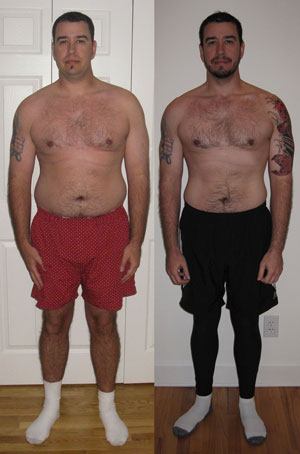
Instructor Before & After: Shawn


After a startling comment made by a coworker Shawn Gorrell faced the mirror and addressed the excuses he'd been making.  After 7 camps, Shawn is now an instructor at our Mercer  location.  
what brought you to boot camp?
I was at a conference and one of my colleagues asked me “Why have you gotten so fat?”. That made me realize that all of the fat looking pictures I’d been explaining away as “bad angles” were just excuses. I knew that it was time to make a change. Then I saw my friend Dean’s blog about OBC, and I started asking him questions about it and got up the guts to give it a try. Originally I was only planning on doing a month, with the idea of getting my own workout on track, but I got hooked immediately.
how long have you been doing it?
I’ve been doing bootcamp since September of 2008. I did 7 camps in 9 months, and then started as an instructor at the end of May 2009.
what were your goals?  have you achieved them?  what are they now?

As a camper, my nebulous goal was “fab by 40”, which I wasn’t entirely sure exactly what it meant, but figured I’d know when I saw it. To get there I had a couple of main goals that I’d use every month. Goal 1 – don’t miss camp. In my 7 camps, I missed 3 days, 2 where I was out of state for work, and 1 where I was stuck at work overnight. I never missed a day due to injury, illness or excuses. Goal 2 – bring it every day. What I meant by that was that I never wanted to have a day that I looked back on and found my effort to be less than the best I could give. There were days where I’d be tired, but I always gave my personal best. Goal 3 was always a time goal for the mile. My first mile at camp was just under 10 minutes, and my last mile as a camper was a 5:42. As far as my “fab at 40” goal, I knew that I’d hit that when I put an after picture next to a before picture and was shocked and satisfied.

Now that I’m an instructor my goals are always moving around. Normally they are around races, either time goals, or number of races. Before I was a camper I hated running and had never run a race. Now I’m addicted to running races and will do my first marathon this year. First year as a runner I did 12+ 5K’s and 2 10K’s. Second year as a runner, I did 12+ 5 and 10Ks, and 2 half marathons. And this year I’ll do the same number of 5 and 10Ks, 2 halfs and a full marathon. I’ve also got a goal of my first sub 5:00 minute mile this year. Next year I think that I’ll start competing in sprint triathlons. My big goals as an instructor every month is to get the best out of every one of my campers and for us to have fun at every workout. I don’t want a day to go by where we don’t have smiling campers. A workout can be both hard and fun…

what are your results?

When I started bootcamp I weighed right around 240 pounds, and at the end of my last month as a camper I weighed 193. Since becoming an instructor, I’ve never been more than a pound or two over my final camper weight and have been as light as 181, depending on my run training schedule. Looking back at the first PT test I did as a camper, I did 25 pushups in a minute. Last Friday when we did PT test I did 61.

what were you expecting? (were you nervous? did you feel better?)

Before I talked to my friend Dean about what camp was all about, I thought that bootcamps were a place where you ran around and people yelled at you. I found that idea to be totally unappealing. Fortunately he told me that the environment was positive and that nobody would yell at me, but instead would be yelling for me. That was enough to convince me to at least try it. I was very nervous on the first day or two of camp, but once I figured out that nobody was going to be yelling at me, I got over it. I was also kind of nervous that other campers who were more fit would look down on me, but I found out quickly that the other campers have the same insecurities I did and that we all supported one another.

what would you tell someone who was nervous about joining?

I would tell them what that they have exactly the same fears that I did, and that they’ll quickly find out that there is nothing to be afraid of. Nobody is out there to judge anyone else. I tell my campers that my goal is to get each one of them *their* best workout every day and have fun doing it. It’s about getting their best, not someone else’s. 

what has been the most surprising?

That I got so hooked to doing something like this every day and being up before 5 to do it, and that I actually enjoy running. Before camp, I was an avid hater of running. I played sports, but the idea of running for enjoyment was inconceivable. I think that a lot of people talk themselves into “hating” running, but the reality is that they might be really good at it and enjoy it greatly if they give it a try. I would never have believed that before camp.

how have the instructors helped you?

When I was a camper I could tell that the instructor team truly cared about all of us, and they always seemed to have the right word of encouragement at the right time, when I needed it most. They also kept me accountable to my book, goals and level of effort. When I reached the point of fitness where I was at the front of the pack, they didn’t let me give less than my best.

I think that just about any place can get you a good workout, but what makes OBC different is how they treat people. In my time as a camper and instructor I’ve been to workouts at camps all over town, and what I’ve found is that the instructor teams are consistently good and have a focus on people and relationships. People come to camp to get fit, and they stay in camp because of the relationships they develop. There are people that I was with in my first month of camp that I’m friends with outside of camp 2 ½ years later. If it were just about the workout, I don’t think that would happen.

how has it impacted your life?

People wouldn’t recognize the life I have now compared to before coming to camp. Besides the weight loss and the changes that go along with that, my diet is radically better than it ever was before. I took the lessons learned at camp and made them a part of my lifestyle. Camp got me into running, and now I plan vacations and significant events around my race schedule instead of the other way around. One of the things we talk about at camp is “getting out of the comfort zone”, and I came to learn that the idea has just as much meaning in the rest of my life as it does in camp. I figured out that the best things in life are discovered when you take a risk and step farther than you thought you could, and when you quit listening to the negative inner voice that’s always telling you what you can’t do.

what unexpected things happened (emotional? family impacted?)

One of the nice unexpected side-effects of camp is that my overall stress levels have went down immeasurably. There is something about getting your butt kicked at 6am that makes the rest of the day seem much easier. Many of the things that would pop up in a day to ruin it will now just make me laugh, because I realize how trivial they really are.

what's been the most challenging?

The most challenging thing was actually just getting started. Once I started and got hooked, I can’t say that there is anything I think is a huge challenge. Sure there are days when I’d rather be sleeping in, or when I might have a flat workout, but they are the exception. I have fun at camp every day.

what's your favorite workout?

Anything with sprints or bands.  My overall favorites are Full Metal Jacked or 20-20-20 for sprints workouts, and 21 Gun Salute for bands. Rifle Run is one of my favorites too.

Monday, February 7, 2011

Herb-Crusted Chicken and Parsley Orzo

Herb-Crusted Chicken and Parsley Orzo
Make this yummy dish on any week night- you probably already have the ingredients and it only takes 20 minutes!
Yield: 4 servings (serving size: 1 breast half and 1/2 cup orzo mixture)

Ingredients

  • 3/4  cup  uncooked orzo
  • 2  tablespoons  butter, divided
  • 1/2  teaspoon  salt, divided
  • 1/4  teaspoon  black pepper, divided
  • 4  (6-ounce) skinless, boneless chicken breast halves
  • 4  teaspoons  dried fines herbes
  • 1  tablespoon  olive oil
  • 2 tablespoons fresh parsley

Preparation

1. Cook orzo according to package directions, omitting salt and fat. Drain. Stir in parsley, 2 teaspoons butter, 1/4 teaspoon salt, and 1/8 teaspoon pepper. Keep warm.
2. While pasta cooks, sprinkle chicken with the remaining 1/4 teaspoon salt and the remaining 1/8 teaspoon pepper; sprinkle fines herbes over both sides of chicken, pressing gently to adhere.
3. Melt remaining 4 teaspoons butter in a large nonstick skillet over medium heat. Add oil to pan, and swirl to coat. Add chicken to pan; cook 5 minutes or until browned. Turn chicken over; cook 7 minutes or until done. Remove chicken from pan; let stand for 3 minutes. Serve chicken over orzo mixture.

Nutritional Information

Calories:
342
Fat:
11.4g (sat 5g,mono 4.3g,poly 0.9g)
Protein:
33.9g
Carbohydrate:
24.4g
Fiber:
2.6g
Cholesterol:
89mg
Iron:
2.6mg
Sodium:
428mg
Calcium:
96mg

Friday, February 4, 2011

Running Form Tips

by Carl Leivers

One of the biggest sources of confusion for runners is whether their form is "correct."  Improving your form will help you run longer and faster with the same effort, and can help you avoid injuries.  So what's the "correct" form?  Every runner is unique, but there's some general principles that will make sure you're getting the most out of every step.

FEET UNDER YOUR HIPS
You may have heard talk recently about running on your mid-foot or toes instead of on your heels.  This allows you to take advantage of the body's natural shock-absorbing mechanisms -- helping to reduce injuries and increase efficiency.  In my experience, though, it's difficult to tell what part of your foot is landing first and even harder to change it.  So I coach my runners to focus on where their foot is landing compared to the rest of their body.  If you're landing with your foot underneath your knee and in line with your hips (rather than out in front of them), then you're going to naturally land on your mid- or forefoot.  The easiest way to make sure that's happening is to ...

TAKE SHORTER STRIDES
Studies have shown that the most efficient runners have approximately 180 footfalls a minute -- 3 a second!  Clearly if your feet are going to be hitting the ground that frequently, you're not going to be able to have a very long, loping stride.  By shortening your stride, you'll make sure your foot is landing underneath you, and you'll also reduce wasted energy.  Remember that if you can increase your efficiency, you'll be able to run faster and longer with the same effort.  So shorten up your strides and make sure that all your energy is going toward moving you forward.  Speaking of wasted energy ...

ARMS ALONG FOR THE RIDE
Your upper-body can waste a lot of energy while running.  That's because your arms really shouldn't be doing much more than helping your body maintain its balance.  It may look dramatic to pump your arms like a sprinter, but it really isn't helping when you're running for distance.  A good rule is to make sure that your arms never swing across the mid-line of your body.  Also, keep them "hinged" at the shoulder -- meaning that they swing freely from the shoulder, rather than pump forward and backward.

Applying these simple fixes may seem awkward at first, but after a few weeks you'll be gliding along, with plenty of energy left for your finishing kick!


Carl Leivers is an experienced runner and the men's cross country and distance track coach at Emory University.
Coach Carl believes in the importance of having a progressive training plan that is personalized to one's own strengths, weaknesses, and goals.  He offers private coaching and training programs.  Find out more at runningcoachcarl.com

Followers